
The short answer: if the door swing is genuinely eating your counter clearance, the Ninja Flip is the right call. If baking performance matters more than the door trick, the Breville Compact Smart Oven still earns its spot. But those two sentences miss most of what matters when you are standing in a 60-inch-wide galley kitchen trying to decide whether a toaster oven is worth the real estate.
I have used the Ninja Flip Toaster Oven Combo in my Brooklyn apartment kitchen for four months, testing it against the Breville Compact (the BOV450XL, the older compact model that still sells well and hovers around $150 to $180). Both machines sit in roughly the same price neighborhood. Both are genuinely compact. The differences are specific, and they matter a lot depending on your exact kitchen situation.
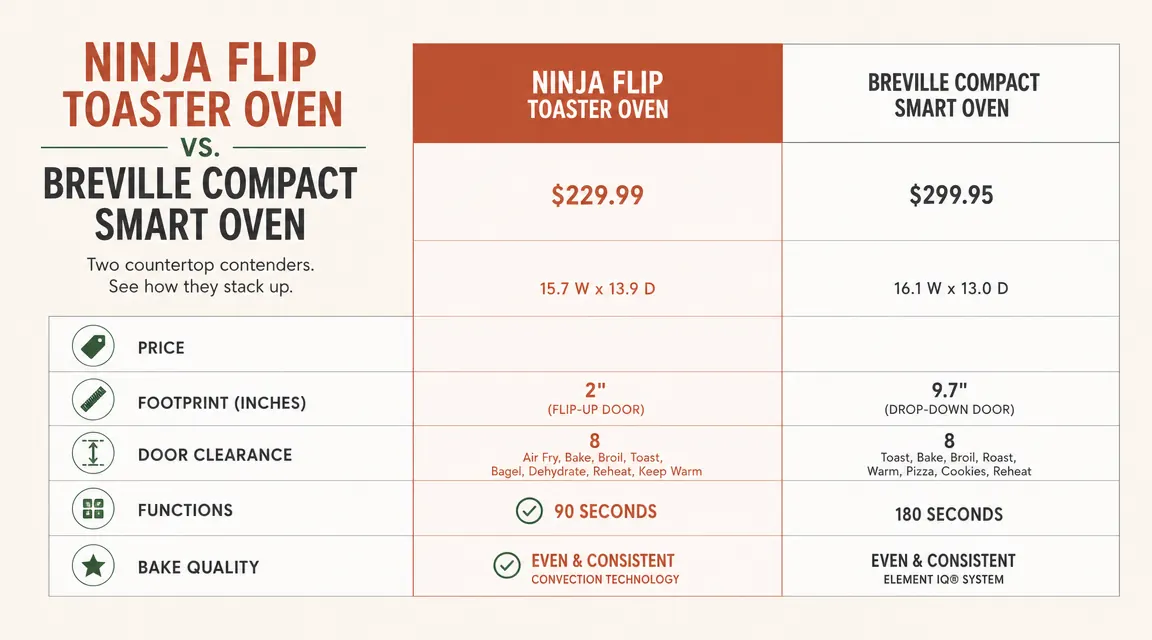
| Spec | Ninja Flip Toaster Oven | Breville Compact |
|---|---|---|
| ~$160 | ~$170 | |
| 15.6" x 14.3" | 16.3" x 14.4" | |
| 0" (flips up) | ~14" in front | |
| 0.6 cu ft | 0.45 cu ft | |
| 8 (Air Fry, Toast, Bake, Roast, Broil, Reheat, Dehydrate, Pizza) | 4 (Toast, Bake, Broil, Roast) | |
| Fast (~4 min to 400F) | Slower (~7 min to 400F) | |
| Good, some hot spots | Very good, element sensor helps | |
| Yes, dedicated mode | No | |
| 4.6 stars (29,555 reviews) | 4.4 stars (~18,000 reviews) | |
| Removable crumb tray, non-stick interior | Removable crumb tray, bare interior walls |
Where the Ninja Flip Wins
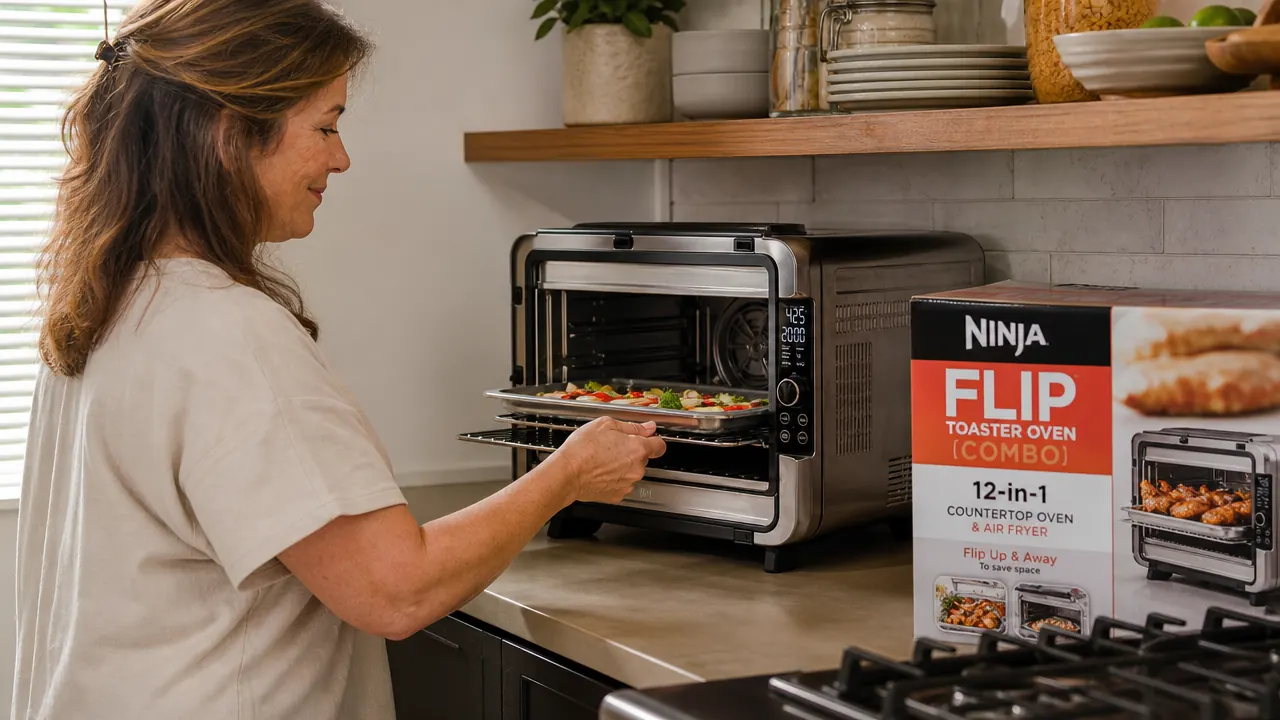
The flip door is not a gimmick. In my kitchen, the toaster oven lives between the microwave and the coffee maker on a narrow stretch of counter. With a traditional front-swing door, you need dead clear space in front of the unit equal to the door's length, roughly 13 to 14 inches. That clearance has to stay clear the whole time you are cooking. With the Ninja Flip, the door folds straight up against the unit face. You still need to reach in, but you are not blocking the counter in front of it while the oven runs. For a kitchen where two steps of counter depth is everything, that is a real win.
The second win is versatility. The Breville Compact does four things. The Ninja does eight, including a legitimate air fry mode with a dedicated basket. If you are trying to consolidate, and most small-kitchen cooks are, the Ninja can replace a standalone air fryer, which means one less thing on the counter or in the cabinet. The air fry results are not quite as good as a dedicated basket air fryer at the same price point, but they are close enough that most people stop caring after a few weeks.
Preheat speed also breaks Ninja's way. I clocked the Ninja at four minutes to reach 400 degrees and the Breville at just over seven minutes for the same temperature. In a normal kitchen that difference barely matters. In a small apartment where you are often cooking for one and you want dinner done in 25 minutes, that three-minute gap is genuinely felt.
Where the Breville Wins
The Breville Compact uses a sensor called Element IQ that redistributes power between its heating elements based on what you are cooking. The result is more even baking, especially for things like cookies, muffins, and casseroles where hot spots show up as one side done and the other side pale. I baked a batch of chocolate chip cookies in both machines. The Breville came out more consistently golden across the whole tray. The Ninja had a slightly darker back row. It is not a disaster, but if baking is a priority, the Breville is the better machine.
The Breville also has a simpler, cleaner control interface. The Ninja has eight cooking modes plus time and temperature dials plus a separate Start button and a function dial. First-time use takes a few minutes to orient yourself. The Breville is basically a dial and a button. Some people find the Ninja overwhelming at first, though it becomes second nature quickly.
If the door swing is eating your clearance, the Ninja Flip is the fix.
The Ninja Flip Toaster Oven Combo pairs a door that folds up and away with eight cooking modes, including a real air fry function. For a small kitchen looking to consolidate, it is hard to beat.
Amazon Check Today's Price on Amazon →The flip door frees roughly 14 inches of counter clearance in front of the oven. In a 6-foot galley kitchen, that is not a small detail.
Who Should Buy Which
Buy the Ninja Flip if: your counter setup has limited clearance in front of where the oven sits, you want one machine to cover both air frying and oven cooking, or you cook with speed as a priority. The flip door alone justifies the choice for anyone in a galley kitchen where counter depth in front of the oven is borrowed from the main work surface. Add the air fry capability and the faster preheat and it becomes the easier yes.
Buy the Breville Compact if: baking is a significant part of how you cook and uneven results would frustrate you, or if you want a simpler interface and are not interested in the air fry function. The Breville also holds its value better on the used market, which matters if you move or downsize again and want to sell rather than donate. Both machines are within $10 to $20 of each other at current pricing, so the decision should not come down to budget.
One more thing worth saying: if your current oven situation is a full-size apartment oven that takes 20 minutes to preheat, heats the entire apartment, and is mostly empty when you cook for one or two people, either of these compact toaster ovens will likely become the appliance you use 80 percent of the time. The counter trade-off pays for itself in energy, heat, and time within the first month.
The Ninja Flip handles toasting, baking, roasting, and air frying without swinging a door into your workflow.
Over 29,000 Amazon ratings at 4.6 stars. The flip-up door and 8-in-1 functions make it the most space-efficient toaster oven on the market for small kitchens.
Amazon Check Today's Price on Amazon →